
India, Pakistan, and the Reverberations of Partition
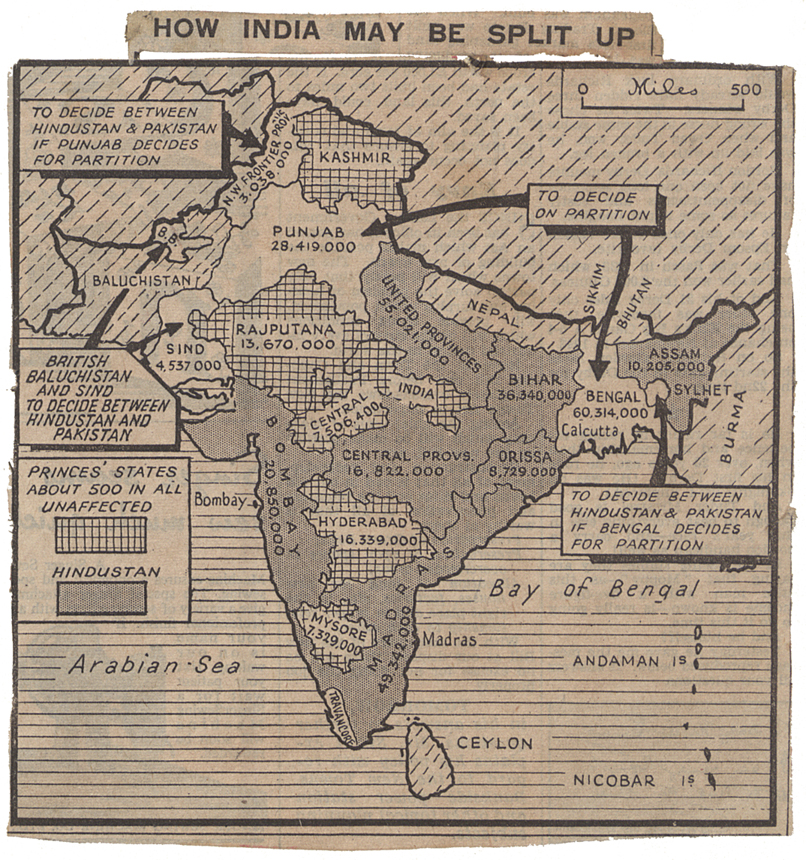
The partition of British India in 1947 primed the two newly independent states of India and Pakistan for a trajectory of war in a variety of different ways. While the partition was intended as a reluctant solution to a conflict already taking place within the imperial territory, it instead transformed that conflict into a hallmark of the interactions between the two states. Partition may not have been the sole cause of the Indo-Pakistani conflict, but it did have a profound impact on the internal structure of the post-colonial states, the way each state viewed themselves and their counterpart, the continuing border dispute over Kashmir, and the broadly hostile Hobbesian way in which relations are generally conducted, setting the stage for an often violent rivalry with seemingly no way out. These impacts will be examined in detail here, following a history of the partition to provide the necessary context.
Towards Partition
Throughout the 1930s and 1940s the inevitability of the British exit from India became clear, and Britain began to make hasty preparations. The independence movement was dominated largely by the Congress Party under the leadership of Mahatma Gandhi and Jawaharlal Nehru, who envisioned a single secular and united Indian state. In the years leading up to independence, that vision was contested by Muhammad Ali Jinnah, leader of the Muslim League, who sought the establishment of a separate state for India’s large Muslim minority.1 Although this was initially a marginal call, and the prospect of dividing India was widely unfavourable, Jinnah’s Muslim League grew in influence, particularly amidst growing bitter religious violence that left Muslims (as well as Hindus, Sikhs, and others) feeling victimised and persecuted, increasing the attractiveness of statehood.2 This clashed with Britain’s hopes for a united yet decentralised federal structure for India, as well as the Congress’s rejection of statehood along religious lines. The debate over India’s future grew into a crisis with intercommunal violence frequently breaking out and the future uncertain, which only accelerated British attempts to find a solution as quickly as possible before further deteriorations could occur. Massacres and riots killed between 5,000 and 20,000 in Calcutta over a few days in August 1946 following a breakdown in negotiations surrounding a plan for a united federal India,3 and partition began to be seen as the only viable option remaining and the last hope for preventing the total violent collapse of India. Lord Mountbatten was sent to India by the British government in March 1947 to oversee the final transfer of power by 1948, with partition as the solution he reluctantly decided upon. Nehru and the Congress conceded to this when it became clear that securing any agreement on a united India would come at the cost of such extensive decentralisation that they would be sacrificing any semblance of the strong central Indian state that they were fighting for.4 Jinnah agreed to this plan, and in June 1947 it was decided that India was to be partitioned.
British India at the time was divided between provinces ruled directly by Britain and princely states ruled by autonomous local leaders.5 Most provinces joined either India or the new Pakistan in their entirety, but Punjab and Bengal were further divided between the two, with the precise borders decided by Cyril Radcliffe.6 The princely states were nominally free to determine their own path, though in practice were given the options of acceding either to India or Pakistan. By the time of independence, all but three princely states had acceded to one or the other. Two of those were quickly annexed by India after independence, leaving only Jammu and Kashmir unsettled.7 On 15th August 1947, India and Pakistan gained their independence, only two months after the division of India into two states had been conceptually agreed upon. The new borders dividing both Punjab and Bengal were drawn so quickly and so late that they were not yet known to either government until two days after independence, establishing chaos and insecurity as the norm from the second the states were born.8 Punjab and Bengal were largely divided as to minimise the number of Muslims on the Indian side and non-Muslims on the Pakistani side, though given the religiously mixed nature of the regions, this was impossible to achieve completely. Countless communities were left stranded on the “wrong” side of the border and an enormous wave of disorganised migration was triggered. Around 12 million people fled haphazardly across the new borders, and the chaos that ensued killed between two hundred thousand and two million people.9 ‘Murder, pillage, arson, rape - all of these words can fit accurately what happened … Trains arrived with their whole passenger complement silent - unable to speak because all were decapitated or stabbed to death.’10
Kashmir
Jammu and Kashmir represented another challenge, as its sovereign question remained unanswered. The princely state had a Muslim majority but was ruled by a Hindu, Hari Singh, who refused to join both India and Pakistan. Having acceded to neither by 15th August, this left it independent in most respects, but riots broke out and a local Muslim rebellion in favour of joining Pakistan was soon underway, with the support of Pakistani militias who swiftly crossed into Kashmir.11 Singh turned to India for help, signing an accession document in exchange for Indian support in October 1947, with Pakistani and Indian troops clashing in Kashmir for the first time thereafter.12 Thus, the very act of partition thrust the two new states into their first war from the moment of independence. The ceasefire line agreed in January 1949 remains largely unchanged as the de facto Indo-Pakistani border to this day.13
The border dispute over Kashmir is the most obvious impact of the partition on the culture of war between the two, having led to wars in 1947, 1965, and 1999, as well as continuous smaller clashes nearly constantly.14 Hostilities remain pervasive because each side has so much at stake, with Kashmir being central to the national image of both states.15 For Pakistan it is a natural and rightful part of their Muslim nation-state, which already emerged after partition so much smaller and weaker than they had hoped for.16 With the mandate to guard and provide statehood to India’s Muslims, Pakistan cannot then lose Kashmir after setting out to defend its Muslim population – segments of which were already agitating to join Pakistan – from perceived Indian aggression.17 For India, incorporating a Muslim-majority region into their state is a symbol of their claim to being a secular, multi-religious state and a rejection of the religious nationalism which partition represents.18 Letting go of Kashmir could threaten the sovereign integrity of India by legitimising and emboldening other separatist movements, such as the Khalistan movement.19 The importance to India of Kashmir can be seen in Article 370 of the Indian constitution, which laid out autonomy for Kashmir but in doing so implicitly enshrined it as being Indian territory.20
Kashmir’s Himalayan geography also makes it isolated both culturally and infrastructurally, meaning it is difficult to effectively integrate into the structures of any larger state, whether India or Pakistan, making a conclusive peace more difficult.21 For the same reason, its borders are very challenging to demarcate or control, allowing drugs and terrorism to flow smoothly across, creating security concerns and intensifying the sources and stakes of conflict.22 Exacerbating this is Kashmir’s highly strategic location, bordering both Afghanistan and Xinjiang in China; hotspots of drug trafficking and radical Islamist groups. Thus, Kashmir’s enigmatic borders not only increase the likelihood of flare-ups between Pakistan and India but are also perceived by India as a serious security threat due to the risk of terrorist activity.23 This is especially the case since the insurgency in Indian administered Kashmir began in 1989, with a range of participating groups, some of which are recipients of Pakistani support to various extents.24 This increases Indian hostility towards Pakistan, while India’s heavy-handed response in Kashmir only antagonises Pakistan further, creating a vicious cycle of insecurity and conflict.
Conceptions of Statehood
This cycle extends far beyond just Kashmir; partition established fundamentally irreconcilable visions of the basis of Indian and Pakistani statehood, with each threatening the national project of the other. India was to be united, representing Indians of all religions, thus inherently opposed to and threatened by separatist religious nationalism.25 The very idea of an independent Pakistan contradicts the founding image of a singular, free, pluralistic Indian state. Pakistan thus lacks ideological legitimacy, existing as a testament to colonial interference which carved up and weakened India’s rightful foundations. Conversely, Pakistani statehood is predicated on the idea that it is the homeland of all of India’s Muslims, making it irredentist from the very beginning towards the Muslims remaining within India’s post-independence borders, not satisfied with the territory they were given compared to the maximalist territorial vision they would have hoped for.26 Their perception is that they had to fight every step of the way for statehood, with the Congress Party doing everything possible to prevent Pakistani independence, and ultimately succeeding in reducing Pakistan’s final territorial extent to an undesirable degree, leaving a large number of Muslims still within India’s borders.27 Thus even where the two states had no official border dispute, they were left with a lingering sense that the other’s territorial claims and fundamental sovereignty were invalid. Exacerbating this was the rushed and dictated nature of the partition; although both parties agreed to partition in principle, they were not made aware of the final borders until after independence was already upon them.28 This inevitably provided a sense of colonial artificiality to the borders, as well as encouraging the dangerous impression that they could still be changed. What ultimately ‘persuaded the leaders to accept them was not so much the fact that any of them was satisfied, as the growing realisation that their opponents were as bitterly unhappy as themselves’.29
As was already mentioned, the desperately rushed finalisation of the borders in the days after independence triggered an enormous wave of disorganised migration characterised by unprecedented human suffering. This migration imprinted itself on each state at the moment of their independence and established the tone of relations as being brutally violent and marked by complications and hostilities.30 Nonetheless, this relationship was central to the identity of both states; each defining themselves in opposition to the other. As the populations of India and Pakistan transferred and homogenised, the populations of Delhi and Karachi (Pakistan’s first capital) exploded, bringing a swell of refugees close to the centres of political power.31 These migrants brought with them the horrors of their journeys, each bearing stories of Muslim/Hindu brutalities, leaving a deep mark on the newly unfolding national identities and permanently shaping the demographics and political culture of their new states.
The impact of the partition on domestic political culture was thus significant for both India and Pakistan, helping to entrench and perpetuate the conflict. Pakistan’s perception was that India had never fully accepted the partition or Pakistani statehood, meaning that they were always under threat.32 Events in Kashmir and the atrocities associated with the migration only solidified this viewpoint. Being the smaller and weaker of the two states, Pakistan’s domestic priority therefore immediately became military defence. Military expenditure took up an enormous 70% of the national budget in the immediate years following independence, meaning that the cultivation of a democratic structure or civil society was inevitably sacrificed in favour of consolidation and development of the military.33 This gave the military a crucial political role, being seen as the valiant guardian of the nation’s fragile sovereignty (even more so than for most other states), especially given the war in Kashmir. This importance allowed them an increasing degree of political influence, encouraging active participation and interference which culminated in Pakistan’s first military coup in 1958.34 The decision in Pakistan’s early years to prioritise the military above all other considerations set them down a path of military preponderance that continues today. This in turn leads to a predisposition towards more military-oriented solutions to the conflict with India – including a willingness to support insurgent and terrorist activity within India – which increases the likelihood of war, amplifies India’s own security concerns, and deepens their suspicion towards Pakistan.35
India, for their part, have also had their domestic political culture marked inexorably by the partition. The failure of the Congress Party’s attempt to bring about India’s independence as a united state prompted various ideological debates and developments within post-colonial India. One of these was the trend towards centralisation: having undergone one partition – which began simply with calls for greater representation and autonomy – India became deeply suspicious of any other calls for regional, linguistic, ethnic, or religious autonomy, fearing that they could lead to a second partition of the subcontinent.36 This would run counter not only to India's credibility as a civic nation-state, rejecting the logic of religious nationalism and espousing itself as the pluralistic heir to all of British India's land and people, but also to the understandable desire to avoid a second humanitarian disaster that might follow another partition. The first partition still evokes imagery of near-apocalyptic suffering; it is traumatic even today, and India has made it a priority to avoid another such tragedy. Thus India employs heavy-handed and often counterproductive repression against movements that could threaten its sovereignty, such as the Sikh insurgency to establish an independent Khalistan.37 That insurgency intensified in 1984 after the Indian military raided the Golden Temple – the holiest place in Sikhism – attempting to root out Sikh militants who were occupying it, in an operation that likely killed between 1,000 and 10,000 civilians and caused irreparable damage to various religious artifacts within the temple.38 This forceful approach is applied to Kashmir as well, with India keen to maintain their sovereignty over that territory in an effort to avoid both a cascade of other separatist movements threatening their territorial integrity and difficult questions about the basis of India’s national identity. This repressive approach ironically only provides more space within Kashmir for intense reactive separatism to take hold, as well as inflaming Pakistani relations, with Pakistan then supporting and amplifying various Kashmiri separatist groups.39
Hindutva
Another linked, yet separate, political development that the reverberations of partition have brought to prominence is the rise of the Hindu nationalist ideology termed Hindutva. The independence of a nation-state for Indian Muslims, the trauma of the religious violence of the partition, a history of struggles between the Indian central state and various movements for autonomy or separatism, and continuing tensions with Pakistan have all contributed to fuelling an ongoing debate about the place of the existing Muslim minority within Indian society.40 There is much disagreement over whether India should exist as a secular state or instead embody Hindutva, becoming a Hindu nation-state. If Indian Muslims can have their state, why not Indian Hindus? Partition has provided the political space for such an ideology to take hold, which represents new challenges for India’s many minority groups as their place in society and the legitimacy of their Indian identity is questioned, leaving India’s Muslims under particular threat. Actions like the destruction of the Babri Masjid, a historically significant 16th century mosque demolished in 1992 by a Hindu nationalist mob,41 or the 2002 riots in Gujarat which targeted mostly Muslims, hundreds of whom were killed while more were raped and mutilated42 not only vastly increase the incentives for Kashmiri Muslims to keep fighting against incorporation into an increasingly Hindutva-dominated India, but also make establishing constructive relations with Pakistan much more difficult. Since Modi’s BJP government came to power in 2014, Hindutva has been government ideology, representing a clear break from India’s secular tradition.
However, this is by no means a clear break from the legacy of partition. Conversely it was partition that allowed for Hindutva’s rise, with the trauma associated with it, the immortalisation of Hindu-Muslim violence, the defining of relations with Pakistan, and the regional validation and legitimisation of religious nationalism all providing the conditions for Hindutva to establish itself.43 Indeed, in 2021 Modi himself designated 14th August to be the annual Partition Horrors Remembrance Day, with the BJP’s National General Secretary responding by acknowledging the sacrifices Indians made, bemoaning their loss of territory, and accusing the Congress Party of whitewashing partition’s legacy.44 The trauma of partition thus plays a central role in Hindutva, which nonetheless entrenches the cycle of Indo-Pakistani enmity, simply evolving it from being between Muslim nationalism and secular Indian nationalism to between Muslim nationalism and Hindu nationalism. This has ramifications for Kashmir as well, with Modi’s government nullifying Article 370, thereby removing the autonomy that Kashmir was constitutionally granted, opening it up significantly to centralised rule.45 Kashmir remains a key part of national identity under Hindutva, but with secular acceptance of Kashmir’s mostly Muslim religious identity replaced by Hindu nationalist opposition to Kashmiri autonomy and fierce defence of the Hindu minority in Kashmir, with the unforgiving stance against insurgency and Pakistani interference remaining unchanged.46 Thus, Kashmir holds paramount significance in India’s foundational myth of partition, independence and the mortal struggle against Pakistan, regardless of whether the prevailing ideology is secular or Hindutva.
Conclusion
Partition has therefore had broad and deep impacts on the relationship between India and Pakistan, entrenching a pattern of conflict between them, leaving relations almost permanently hostile and keeping both states in a warlike mindset primed for conflict, even when there officially is none. Specifically, partition established this pattern through its role in the intractability of the dispute over Kashmir, the irreconcilable foundations of Indian and Pakistani statehood, the role that the human consequences of partition have played in the founding myth of each state, the strong legacy of militarism in Pakistan and its encouragement of terrorist activity, and the dual legacies of centralisation and Hindutva in India. With Hindu-Muslim tensions existing long before 1947, partition may not have been the sole cause of the conflict, but it undeniably shaped its contours, keeping both states locked structurally into conflict against each other until even today, with very little prospect of either India or Pakistan being able to change course in the foreseeable future.
Endnotes
- Graham Chapman, The Geopolitics of South Asia: From Early Empires to the Nuclear Age (Routledge, 2018), 160.
- Chapman, Geopolitics of South Asia, 160.
- Chapman, Geopolitics of South Asia, 162.
- Chapman, Geopolitics of South Asia, 171.
- Sumit Ganguly, “Wars Without End: The Indo-Pakistani Conflict,” The Annals of the American Academy of Political and Social Science 541 (1995): 169, http://www.jstor.org/stable/1048283.
- Chapman, Geopolitics of South Asia, 172.
- Chapman, Geopolitics of South Asia, 184–186.
- Chapman, Geopolitics of South Asia, 182.
- Ian Talbot, “Legacies of The Partition for India and Pakistan,” Politeja, no. 59 (2019): 8, https://www.jstor.org/stable/26916350.
- Chapman, Geopolitics of South Asia, 191.
- Chapman, Geopolitics of South Asia, 188.
- Ganguly, “Wars Without End,” 170.
- Deepti Sharma, “The Kashmir Insurgency,” in Ethnic Subnationalist Insurgencies in South Asia, ed. Jugdep S. Chima (Routledge, 2015), 19.
- Another war between the two took place in 1971, but that conflict was linked to Bangladesh’s war of independence, rather than the Kashmir dispute. Ganguly, “Wars Without End,” 168.
- David Gilmartin, “The Historiography of India’s Partition: Between Civilization and Modernity,” The Journal of Asian Studies 74, no. 1 (2015): 25, http://www.jstor.org/stable/43553642.
- K. Sarwar Hasan, “The Real Issue in The Present India-Pakistan War,” Pakistan Horizon 18, no. 4 (1965): 334, http://www.jstor.org/stable/41393246.
- The word ‘Pakistan’ itself is indicative of the importance of Kashmir for Pakistani national identity: the name was created as an acronym of the Muslim majority regions within British India, with ‘K’ standing for Kashmir. Talbot, “Legacies,” 21.
- Talbot, “Legacies,” 22.
- Talbot, “Legacies,” 16.
- Sharma, “The Kashmir Insurgency,” 19.
- Judith Matloff, The War is in The Mountains (Duckworth Overlook, 2017), 157.
- Rathnam Indurthy and Muhammad Haque, “The Kashmir Conflict: Why it Defies Solution,” International Journal on World Peace 27, no. 1 (2010): 22, http://www.jstor.org/stable/20752914.
- Indurthy and Haque, “The Kashmir Conflict,” 22.
- Sharma, “The Kashmir Insurgency,” 19.
- Talbot, “Legacies,” 16.
- Chapman, Geopolitics of South Asia, 172.
- Hasan, “The Real Issue,” 333.
- Chapman, Geopolitics of South Asia, 182.
- Chapman, Geopolitics of South Asia, 182.
- Talbot, “Legacies,” 9.
- Talbot, “Legacies,” 9.
- Hasan, “The Real Issue,” 334.
- Talbot, “Legacies,” 21.
- Indurthy and Haque, “The Kashmir Conflict,” 23.
- Indurthy and Haque, “The Kashmir Conflict,” 22.
- Talbot, “Legacies,” 11.
- Talbot, “Legacies,” 16.
- Virginia Van Dyke, “The Khalistan Movement in Punjab-India and The Post-Militancy Era,” in Ethnic Subnationalist Insurgencies in South Asia, ed. Jugdep S. Chima (Routledge, 2015), 69.
- Repression of the Khalistan movement was counterproductive as well; the Golden Temple raid sparked enormous backlash from Sikhs, heightening the insurgency and leading to the assassination of India’s PM by her Sikh bodyguards shortly after. Van Dyke, “The Khalistan Movement,” 62.
- Talbot, “Legacies,” 10.
- Ajay Verghese, The Colonial Origins of Ethnic Violence in India (Stanford University Press, 2020), 1.
- Talbot, “Legacies,” 17.
- Talbot, “Legacies,” 10.
- The Hindu, “Narendra Modi Picks August 14 to Recall Partition Trauma,” The Hindu, August 14, 2021, https://www.thehindu.com/news/national/partition-horrors-remembrance-day-narendra-modi-picks-august-14-to-recall-partition-trauma/article35907824.ece
- Sameer P. Lalwani and Gillian Gayner, “India’s Kashmir Conundrum: Before and after the Abrogation of Article 370,” United States Institute of Peace (US Institute of Peace, August 5, 2020): 3, https://www.usip.org/publications/2020/08/indias-kashmir-conundrum-and-after-abrogation-article-370.
- Lalwani and Gayner, “India’s Kashmir Conundrum,” 4.
Bibliography
Chapman, Graham. The Geopolitics of South Asia: From Early Empires to the Nuclear Age. Routledge, 2000 (2018).
Ganguly, Sumit. “Wars without End: The Indo-Pakistani Conflict.” The Annals of the American Academy of Political and Social Science 541 (1995): 167–78. http://www.jstor.org/stable/1048283.
Gilmartin, David. “The Historiography of India’s Partition: Between Civilization and Modernity.” The Journal of Asian Studies 74, no. 1 (2015): 23–41. http://www.jstor.org/stable/43553642.
Hasan, K. Sarwar. “The Real Issue in The Present India-Pakistan War.” Pakistan Horizon 18, no. 4 (1965): 333–43. http://www.jstor.org/stable/41393246.
Indurthy, Rathnam, and Haque, Muhammad. “The Kashmir Conflict: Why it Defies Solution.” International Journal on World Peace 27, no. 1 (2010): 9–44. http://www.jstor.org/stable/20752914.
Lalwani, Sameer P., and Gillian Gayner. “India’s Kashmir Conundrum: Before and after the Abrogation of Article 370.” United States Institute of Peace. US Institute of Peace, August 5, 2020. https://www.usip.org/publications/2020/08/indias-kashmir-conundrum-and-after-abrogation-article-370.
Matloff, Judith. The War is in The Mountains. Duckworth Overlook, 2017.
Sharma, Deepti. “The Kashmir Insurgency,” in Ethnic Subnationalist Insurgencies in South Asia, edited by Jugdep S. Chima. Routledge, 2015.
Talbot, Ian. “Legacies of The Partition for India and Pakistan.” Politeja, no. 59 (2019): 7–25. https://www.jstor.org/stable/26916350.
The Hindu, “Narendra Modi Picks August 14 to Recall Partition Trauma.” The Hindu, August 14, 2021. https://www.thehindu.com/news/national/partition-horrors-remembrance-day-narendra-modi-picks-august-14-to-recall-partition-trauma/article35907824.ece
Vaish, Varun. “Negotiating The India-Pakistan Conflict in Relation to Kashmir.” International Journal on World Peace 28, no. 3 (2011): 53–80. http://www.jstor.org/stable/23266719.
Van Dyke, Virginia. “The Khalistan Movement in Punjab-India and The Post-Militancy Era,” in Ethnic Subnationalist Insurgencies in South Asia, edited by Jugdep S. Chima. Routledge, 2015.
Verghese, Ajay. The Colonial Origins of Ethnic Violence in India. Stanford University Press, 2016.